Lesson 3
UNIT 1
Agricultural development
BASIC AGRICULTURE
Agricultural economics
Learn the active vocabulary of the Lesson and be ready to
use it in your further work:
coin
v – вигадувати, створювати; be
nothing but – бути нічим іншим як; curate v – розробляти; demand
n – попит, потреба; supply
n – постачання, поставка; economies
of scale – економія масштабу; pricing
theories – теорії ціноутворення; distribution
policies – політика розподілу; proactive approach – проактивний підхід; reactive approach – реактивний підхід; be bottlenecks – бути обмеженими; be scarce – бути дефіцитними; Product
Manufacturing – виготовлення продукції; Product
Development – розробка продукції; Product
Financing – фінансування продукції; Product
Marketing – маркетинг продукту; Product
Processing – переробка продукції; Product
Regulation – контроль за продукцією; Product
Research – дослідження продукту; Product
Taxation – оподаткування продуктів; Product
Transportation – транспортування продукції; inflow
of limited resources – притік обмежених ресурсів; outflow
of limited resources – відтік обмежених ресурсів; allocation
efficiency – ефективність розподілу; scarcity
n
– дефіцит; ensure
v – забезпечувати; wealth generation – накопичення багатства; relevance n – актуальність; catalyse v – каталізувати; lift v – піднімати; allocating resource – розподіл ресурсів; pivotal adj – ключовий; sustainability n – стійкість, сталий розвиток. Read
and translate the text:
AGRICULTURAL
ECONOMICS Agricultural
economics is a term
coined by combining agriculture and economy and is nothing but a branch of
economics specially curated for agriculture. All the tools of economics, like
demand and supply, economies of scale, pricing theories, distribution policies,
etc., can all be applied to the field. Agricultural
economics increases knowledge of one of the most significant sectors of the
nation. Its tools allow you to project and forecast results, demands, etc. It
helps develop a more thorough and proactive approach to farming rather than the
reactive approach found in traditional farming. Agricultural
economics is a
branch of economics that helps to optimise the use of resources that are
bottlenecks or scarce to increase the efficiency and effectiveness of production
processes. Agricultural
economics can be defined as a study of agriculture from a business point of
view that encompasses the activities that originate with growing the product and
involves: Product Manufacturing, Product Development, Product Financing. Product
Marketing, Product Processing, Product Regulation, Product Research, Product
Taxation and Product Transportation. Thus, Agricultural
Economics studies: 1. The inflow of
limited resources into the agricultural sector. 2. The outflow of
limited resources from the agricultural sector. It involves deciding
the right mix of land, labour, equipment, growing crops, livestock, etc. The
proportion of these things is decided based on the cost and price associated.
Apart from this, it also looks after the problems of allocation efficiency where
there is a choice between alternative uses. Decisions about alternatives are
taken while considering the scarcity of various resources. All resources should
be used in a way that ensures maximum wealth generation. Agricultural
Economics revolves around the scarcity of resources and choices among
alternatives. Thus, this follows the basic principles of economics. There is also find the relevance of micro and macroeconomics here.
Agricultural economics deals with an analysis how the development of the
agriculture sector can catalyse the growth of other sectors to lift the economy.
Thus, the scope of agricultural economics is much wider than just allocating
resources and choosing the right alternatives. This is because, being an
important sector, it is pivotal to the growth and sustainability of the entire
country.
I. Answer the following questions:
1.
What does a term Agricultural
economics mean?
2.
What tools of economics can be applied to agriculture?
3.
What use
of resources does agricultural
economics help
to optimise?
4.
How
can agricultural economics be defined?
5.
What
resources does agricultural economics study?
6.
What
does agricultural economics involve to solve all aspects and problems associated
with it?
7.
What basic
principles of economics do you know?
8.
What vital question of microeconomics can you identify?
9.
What vital question of macroeconomics can you identify?
II. Learn the following groups of:
a)
synonyms:
Soil-land,
distribute-divide, do-act, problem-question, rich-wealthy, labour-work-job,
last-past, significant-important.
b)
antonyms:
Rich
- poor, primitive - complex, war - peace, trust - distrust, obey -
disobey, important - unimportant,live - die, alive - dead.
III. Put the proper form of "to be":
1.
Agricultural economics (to be) a
branch of applied
economics.
2.
Microeconomics (to be) one of the tools of agricultural
economics.
3.
Agricultural
economics of Ukraine (to be) developed now.
4.
Small-scale
production (not to be) able to provide high quality products.
5.
Now the resources in this area (to be) poor.
6.
Livestock (to be) today in Ukraine in a difficult situation.
7.
A major part of agricultural income (to be) exempt from
taxation.
8.
The income of farmers (to be) generally low compared to other
workers.
IV. Translate from Ukrainian into English. State the functions of "to be":
1. Галузь економіки сільського господарства була зосереджена на питаннях фермерського рівня. 2. Ми повинні вивчати проблему зайнятості. 3. Вона збирається працювати у галузі економіки. 4. Вони — студенти Млинівського технолого-економічного фахового коледжу. 5. Торгівля — важлива сфера людської діяльності. 6. Це питання є спірним. 7. П'ять років тому я була учасником конференції присвяченій розвитку економіки сілького господарства в Україні.
V. Fill in the gaps, using the following words: economy, economist, economic, economics, economise, economical.
* MIND: economic relies to the subject of economics, economical means careful, not wasteful.
1. It can be said that an early definition of _____ was an "An Inquiry into the Nature and Causes of the Wealth of Nations". 2. The national _____ is the system of the management and use of resources of a country. 3. It is often possible to _____ if one compares the prices of items before buying them. 4. J.M. Keynes was a famous _______. 5. Inflation may cause a country to be in a bad _______state. 6. It is usually more _____ to buy large quantities of a product than small ones. 7. Investors watch the rate of ___ growth closely. 8. Despite the efforts of the government, the black ___ continues to grow. 9. That car burns so much gasoline that it is not ___ . 10. He lost his job so he has to ___ by using buses instead of taking a taxi.
VI. Read and translate the meanings of the following terms. Translate the sentences with them:
Consumer
-
is a person who buys goods and services for her/his own use and not for
resale.
1.
Consumers have the right to return faulty goods and demand a refund from the
supplier.
2.
Consumer is a person whose wants are satisfied by producers.
Certificate(n)
-
is a written or printed paper issued by an authority as proof of
something.
1.
She receives a certificate of ownership.
2.
Certificate of origin is signed either by the exporter or by an organization
officially appointed to do so.
3.
Certificate of damage is needed by the importer to support his claim on an
insurer or the ship-owners.
Certify(v) -
formally declare something that a certain stated fact is true.
1.
The accused has been certified to be insane.
2. You have to get these accounts certified by an auditor.
VII. Translate the following extract in written
form:
Ukraine’s livestock inventory continued on its three decades-long downward trend and will remain on it in 2021. Declining cattle numbers will lead to lower Ukrainian beef and live animal exports. Although swine numbers increased somewhat by 2021, this increase is expected to be short-lived. Squeezed between weakening pork prices and skyrocketing feed prices, Ukrainian pork producers will not be able to sustain this growth throughout 2021. Pork imports are expected to grow to compensate for a drop in pork production. Overall, the impact of COVID-19 on Ukrainian red meat production and trade has been insignificant, although Ukrainian domestic market distribution channels changed notably.
VIII. Read the text and answer the questions:
1.
What does an agricultural economist do at the micro level?
2.
What do production economists examine?
3.
What do market economists focus on?
4.
What are financial economists concerned with?
5.
What do financial economists focus on?
6.
What is the activity of agricultural economists at the macro
level?
THE
ACTIVITIES OF AGRICULTURAL ECONOMISTS AT:
Microeconomic
Level
Agricultural
economists at the micro level are concerned with issues related to resource use
in the production, processing, distribution, and consumption of products in the
food and fiber system. Production economists examine resource demand by
businesses and their supply response. Market economists focus on the flow of
food and fiber through market channels to their final destination and the
determination of prices at each stage. Financial economists are concerned with
issues related to the financing of businesses and the supply of capital to these
firms. Resource economists focus on the use and preservation of the nation’s
natural resources. Other economists are interested in the formation of
government programs for specific commodities that will support the incomes of
farmers and provide food and fiber products to low-income consumers.
Macroeconomic
Level
Agricultural economists involved at the macro level are interested in how agriculture and agribusinesses affect domestic and world economies and how the events taking place in other sectors affect these firms and vice versa. For example, agricultural economists employed by the Federal Reserve System must evaluate how changes in monetary policy affect the prices of various food commodities. Macroeconomists with a research interest may use computer-based models to analyze the direct and indirect effects that specific monetary or fiscal policy proposals would have on the farm business sector. Macroeconomists employed by multinational food companies examine foreign trade relationships for food and fiber products. Others address issues in the area of international development.
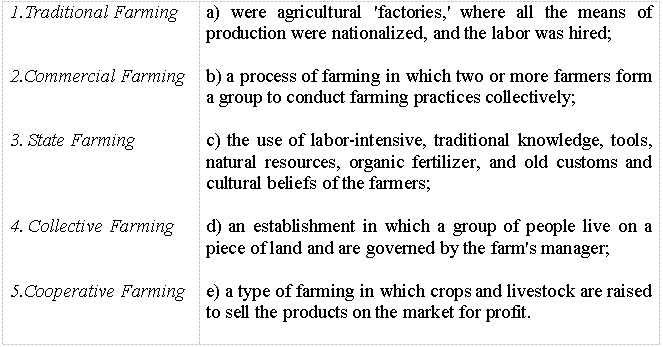
IX. Match the types of farms in agricultural economics with their corresponding definitions:
X. Ask questions on the text and retell it:
THE
CHALLENGES OF AGRICULTURAL ECONOMICS
Fluctuating
Prices
Farmers do not
respond promptly to changes in the demand for the product. Once they plant the
seeds, they cannot do much about increasing or decreasing production until the
next crop cycle. This limitation along with fluctuating prices is the major
drawback of the agricultural
industry.
Unstable
Income
Fluctuating prices
mean unstable incomes. The income of farmers is generally low compared to other
workers. Because of this reason, farmers have very little incentive to continue
farming and not seek employment elsewhere.
The government has
taken measures to alleviate these problems and foster better results among
farmers.
Some of these
measures are as follows:
Subsidies
The government
regularly offers subsidies to farmers on the purchase of fertilizers,
pesticides, machinery, etc to facilitate efficient production.
Taxation
A major part of
agricultural income is exempt from taxation. By doing this, the government
provides direct relief to farmers.
Incentives
The government
offers various incentives to industrialists to encourage them to set up
factories in rural areas to generate employment and foster
development.
Import
Quotas
The government applies various import quotas to match the prices of cheap imported goods with the prices of domestically cultivated products to maintain competition.
XI. Identify the form of the Gerund:
Being examined, making, having weaned, having been done, being repaired, having left, having been translated, trying, being developed, breeding, watering, having bred, having been watered, being pruned, having been fed, feeding.
XII. Translate the word combinations with the Gerund:
To
feed
Feeding calves; by feeding properly; without feeding properly; with the help of feeding properly; before feeding; against feeding new fodder; instead of feeding; for feeding; about feeding calves.