Lesson 8
UNIT 2
My specialty is techologist
BASIC LIVESTOCK PRODUCTION
Care and management of farm animals
Learn the active vocabulary of the Lesson and be ready to use it in your further work:
Animal welfare – добробут тварин;
physical
and mental state – фізичний і психічний стан;
physiological
and behavioural needs – фізіологічні та поведінкові потреби;
measure
n – міра;
careful
observations – ретельні спостереження;
behavior
n – поведінка;
moral
concern – моральна турбота;
arise v
– випливати;
interpret
v – інтерпретувати;
virtue n – позитивна тенденція,
доброчесність;
can
only be acquired through – можна набути лише через;
education
and practical experience – освітній та практичний досвід;
shelter
– притулок;
feeding
– годування;
breeding
– розведення;
barn n – комора; сарай; (ам.) корівник;
bedding n – постільні речі, підстилка;
bull
n – бик;
calf
n – теля;
care
n – турбота,
піклування;
careful
adj – турботливий;
cowshed
n – корівник;
lamb
n – ягня;
management
n – утримання,
керування;
livestock
n – тваринництво;
pigsty
n – свинарник;
sheep-pen
n – вівчарня;
poultry
house – пташник;
humidity n – вологість;
straw n – солома;
pasture n – пасовище.
Read
and translate the text:
CARE
AND MANAGEMENT OF FARM ANIMALS
The
expression ‘animal welfare’ has two distinct meanings. The first is a
description of the physical and mental state of an animal as it seeks to meet
its physiological and behavioural needs. It is a measure of welfare as perceived
by the animal itself and something that we can study through careful
observations of animal behaviour and the disciplines of welfare science. The
second concept of animal welfare is as an expression of moral concern. It arises
from the belief that animals can experience feelings that we would interpret as
pain and suffering, thus we have duty to protect animals in our care from these
things. A concern for animal welfare is obviously a virtue. It is good that we
should care about animals. Caring for animals, however, involves more than
virtue; it requires a sound understanding of the principles of husbandry and
welfare and these things can only be acquired through education and practical
experience.
Farm
animals require proper care and management such as shelter, feeding, breeding,
and disease control. There are 5 areas of animal care and management are
selection, nutrition, health, reproduction, and environment.
A
lot of work has to be done by a farmer in caring for his livestock and their
products. Barns and other building are to be provided in order to protect the
animals from unfavourable weather conditions. Young animals-lambs, calves and
pigs are known to require special care and protection. During the first days
after birth animals are weak and may die if proper care is not
provided.
At
present separate building are usually provided for each kind of livestock such
as cattle, hogs, sheep, and poultry. Cowsheds, sheep-pens, pigsties and poultry
houses should be comfortable for livestock and workers, who take care of the
animals. Much attention is now paid to lighting, ventilation, temperature, and
humidity in animal building. Very often farmers keep bulls in separate
barns.
Probably
no farm animal is more responsive to good care than is the dairy cow. Regularity
in feeding and milking and kindness result in more milk and greater profits.
Dairy cows are to be provided with plenty of bedding, such as clean, dry straw
in the barns where they are kept. When not on pasture cows should take exercise
to be in good breeding condition.
GRAMMAR
EXERCISES
I. Answer the following
questions:
1.Which
distinct meanings has the expression ‘animal welfare’?
2.What
does caring for animals involve?
3.Should
farmers care for animal products?
4.Why
are animals kept in building?
5.Why
do farmers provide special care for young animals?
6.What
farm building do you know?
7.What
conditions are provided in animal buildings?
8.When
should cows take much exercise?
II. Group the following by parts of
speech:
Noun Adjective Verb
expression
physical
seeks
Principles, crops, special, require, consist of, moral,
care, , should care, keep, management, to specialize in, protection, arable,
regularity, are grown, mixed, are used, calves, provide, husbandry, is kept,
dairy, welfare, depends on.
III. Give English equivalents of the following Ukrainian
words:
1.High
beef and milk production is obtained by proper care and management as well as by
proper feeding and fattening of cattle. 2.When
cattle are kept in cowsheds they are fed with corn silage, grass silage and
high-quality hay. 3.Dairy
cows are milked with special machines. 4.There
is always much work to do on the farm. 5.The
farmer has to take great care of the young animals. 6.Cowsheds,
sheep-pens and pigsties are to be kept clean and well ventilated. 7.Cows,
bulls and calves should be provided with clean straw for bedding. 8.Animals
are to take much exercise to be in good breeding condition.
V.
Find the synonyms at the text the following words: Production,
shed, to defend, solicitude, feeble, ox, homestead, accountable, good will, to
supply with.
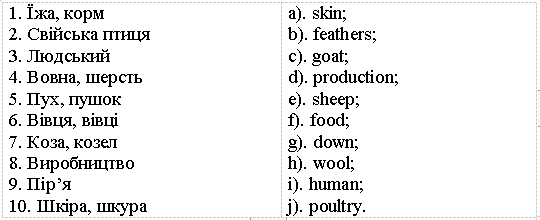
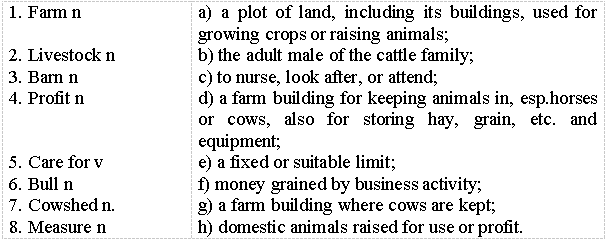
VI. Match the words from the text with their corresponding
definitions:
VII. Translate the wolds paying attention to the words in bold
type: 1.
Much
water and salt should always be available for cattle. 2.
The new sow is much more
prolific than the old one. 3.
Much milk
has been obtained from each cow in this herd. 4.
This method of fattening hogs is much more
effective than the old one.
VIII.
Agree or disagree with the statements according to the
model: Model:
1.Dairy
cattle provide beef. Do you agree with me? No,that
is wrong. Dairy cattle provide dairy products. 2.Beef
cattle are the producer of beef. Do you agree with me? Yes,
that is right (you are quite right). Beef cattle are the producer of beef.
1.
Dual-purpose cattle give us both milk and beef. 2. Hog breeding gives a
vast range of dairy products. 3. The wool and skin of sheep are valuable
raw materials for producing clothes. 4. To poultry belong hens, geese,
ducks, turkeys and pigs. 5. Poultry provide meat, eggs and milk. 6.
Rabbits are bred for meat. 7. The bee is the only producer of honey and
wax.
IX. Translate the sentences paying attention to Participles
forms:
1.The
sow being prolific, the farmer may keep her up to 5 years or longer.
2.Being
weaned at the due time, the pigs will gain in weight rapidly. 3.Animals
receiving balanced rations grow and develop well. 4.Locating
the feed some distance from the pen, we make the animals to take
exercise. 5.Weaning
taking place 7 or 8 weeks after farrowing, the sow may farrow twice
a year. 6.Raising
pigs on good pasture, we fatten them quickly. X. Read the text and answer the following questions:
1.Why
is it best to take individuals from large litters? 2.Should
pregnant sows be fat? 3.What
feeds are used when good pasture is not available? 4.Is
mineral supplement given to sows and pigs? 5.What
ration is fed to the sows tending to fatten excessively? 6.When
are sows placed in farrowing pens? 7.When
do sows and pigs need more protection?
CARE
OF PIGS The
first week of a pig’s life is known to be especially critical. During this
period due temperature, ventilation and sanitation in the pen are most
important. Sometimes it is advisable to put newborn pigs in a warm place and
bring them to their mother every two hours. In four or six hours they may be
left with their mother. Young
pigs begin eating solid food at the age of 3 to 4 weeks. At this age they are
fed a thin slop of milk, wheat middlings and oatmeal. As they get older they may
be fed soaked shelled corn. The feed is usually given to them in a separate
enclosure known as a creep. Due to the creep feeding little pigs may be fed the
best feed. Weaning
pigs is usually done at 6 or 8 weeks of age. The best practice is to remove the
sow from the pen, leaving the piglings in familiar surroundings. During the
period of weaning the ration should be palatable and nutritious. More than 600
pounds of a balanced ration is required in feeding a pig from its weaning until
it has a live weight of about 200 pounds. Some
hog men are known to raise pigs entirely on grain. For such pigs to develop
normally a mineral supplement should be provided. The mineral mixture usually
includes equal parts of steamed bone meal, ground limestone and common salt.
A
study has shown that Young pigs requir more iron and copper than it supplied in
the sow"s milk. That is why they eat some turf and soil. Pigs on good pastures
require 10 to 15 per cent less feed than those raised without pastures. Proper
management is important for success in hog raising. Careful attention during
breeding, farrowing, and rearing the pigs to weaning helps raise a productive
heard. The mor- 63 tality of the young is much higher with swine than with other
kinds of livestock. Since hogs live close to the ground they are subject to many
parasites. The main task of the hogbreeder is to prevent diseases and parasites.
Sanitation is therefore an important problem in hog raising. The rotational
grazing is known to be the best way to prevent diseases and control parasites.
There
are 2 types of swine - the lard and the bacon types. Pure lard breeds are the
Poland, China, the Berkshire hog, the Hampshire, the Mirgorodskaya breed and
others. The bacon type are the Large Yorkshire, the Large White breed, the
Urzumskaya breed and others.
XI.
Translate into English:
Тваринництво, утримувати, порода,
розводити, молочна худоба, трава, м'ясо, молоко, фураж, пасовище, корівник,
свинарник, піклування, сарай, солома, бик, корова, виробляти, підстилка,
освітній та практичний досвід, поведінка, моральна турбота, добробут
тварин, позитивна тенденція (доброчесність), притулок.