Lesson 14
UNIT 3
Livestock production
technology
BASIC PROCESSING TECHNOLOGIES
OF ANIMAL PRODUCTS
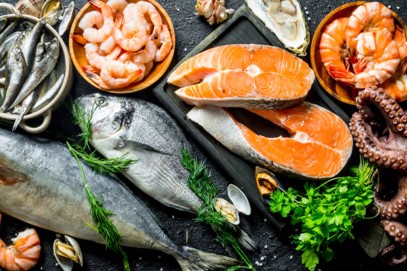
Meat of various types of fish
Learn the active vocabulary of the Lesson and be ready to use it in your further work:
Bacon
– бекон;
beef
– яловичина;
Balanced
p.p. – збалансований;
supply
n.v
– постачання, постачати;
cod
n
– тріска;
haddock
n
– пікша (вид тріски);
mackerel
n
– макрель, скумбрія;
whiting
n
– мерланг (риба);
rock
– fish
n
– морський окунь;
salmon
n – лосось;
trout
n – форель;
herring
n – оселедець;
butterfish
n – маслюк (риба);
peculiar
to
–
характерний (властивий) для;
provide
v – забезпечувати;
iodine
n – йод;
finfish
n – плавникова риба;
shellfish
n – молюск;
clam
n – молюск;
crab
n – краб;
lobster
n – омар;
oyster
n – устриця;
shrimp
n – креветка (маленька);
scallop
n – гребінець (молюск);
squid
n – кальмар;
an
average serving – середня порція (їжі);
species
n
– вид (и) (рослин, тварин);
remove
insides
–
видалити нутрощі (тельбухи) у риби;
fin
n
– плавник;
dressed
fish
–
розділена риба (напівфабрикат);
drawn
fish
– вительбушена риба;
boneless
–
без кісток;
fillets
n
– філе;
scale
fish
чистити рибу від луски, лускати рибу;
caviar
n – ікра.
Read
and translate the texts:
MEAT
OF
VARIOUS TYPES OF FISH
Fish
is about 26 per cent protein, which is complete, well balanced and not easily
affected by the usual cooking method. It is 85 per cent to 95 per cent
digestible. Fish supply 5 per cent to 10 per cent of the National's supply of
animal proteins for human food requirement. The amount of fat in fish is less
than 1 per cent in cod, haddock, whiting, rockfish and sole; to 20 per cent in
salmon, mackerel, lake trout and butter- fish. The fat is easily digested and is
used readily by the body tissues.
Continuing
research has established the nutritive value of some of the unsaturated fatty
acids peculiar to some fish.
The
vitamin content of fish varies an average serving of 3—5 ounces of cooked salmon
and mackerel, which are fat fish, provides about 10 per cent of the daily
requirement of vitamins A and D. The mineral content of the edible part of most
includes satisfactory sources of magnesium, phosphorus, iron, copper and iodine.
Shellfish, clams, crabs, lobsters, oysters, scallops, and shrimp has an
abundance of these minerals — about as much as milk. The softened bones in
canned fish, which are good to eat, are good sources of calcium and phosphorus.
An average serving of six oysters supplies more than the daily need of iron and
copper.
There
are about 200 commercial species of fish, but most people are familiar with
fewer than 20 and recognize even fewer than that on a dinner plate.
The
two major groups of fish — the finfish and shellfish (oysters, clams, blue
crabs, lobsters) — have enough variety to suit every taste and meet every need.
Among the shellfishes are frog legs, turtle steaks, octopus and squid. They are
the less common foods; urchin, a spiny brittle shelled organism, is usually
eaten raw. Sea cucumbers are better known as the dried and smoked «trepang» or
beche-de-mer of the South Seas. Fresh and frozen fish are marketed in various
forms for different uses.
Knowing
these forms of «cuts» is important in buying fish. The best known are:
1.
Whole. As they come from the water. Before cooking must be scaled, and the
insides removed, and usually the head, tail and fins removed.
2.
Drawn. Whole fish with insides removed. Generally scaled before cooking, and
usually the head, tail and fins removed.
3.
Dressed or pan-dressed. Whole fish with scales and insides removed, usually with
head, tail and fins removed. Ready to cook as purchased.
4.
Steaks. Cross-section slices from large dressed fish. Ready to cook as
purchased.
5.
Fillets. Sides of the fish, cut lengthwise away from the back bone. Ready to
cook as purchased. Practically boneless.
6.
Sticks. Pieces of fish cut from the blocks of frozen fillets into portions of
uniform dimentions, usually about one half inch deep, and weigh approximately 1
ounce.
7.
Canned fish. Ready for use and includes many varieties of both fish and
shellfish.
How
to know good fish? In selecting whole fresh fish, look for bright, clear,
bulging eyes, gills reddish, free from slime or odour; firm elastic
flesh-springing back when pressed.
Amounts
to buy. A serving of fish is generally one third to one half pound of edible
flesh.
Therefore,
for whole fish allow about one pound per person. For dressed fish allow one-half
pound per person or three pounds for six people. For steaks, fillets or sticks,
allow one third pound per person or two pounds for six people.
GRAMMAR
EXERCISES
I.
Answer the following questions:
1)
What
is meat
industry?
1.
What is the protein content of fish?
2.
What can you say about animal protein in fish?
3.
What do you know about the shellfish?
4.
What is the good source of calcium and phosphorus?
5.
How many species of fish do you know?
6.
What groups of fish do you know?
7.
How can you tell good fish?
8.
What can you say about vitamin and mineral content of
fish?
II.
Fill in the gaps using the words in the box:
|
Shellfish;
nutrition; liver oil; caviar; amount; extractive
substances; canned;
prevention; herring;
fin-fish. |
1.
Fish takes an important place in food _______. 2. A specific taste and aroma of
fish meat are due to the ________ _______. 3. Salt-water fish generally contain
large _______ of vitamin D. 4. Vitamin D is effective in _________ and cure of
rickets. 5. It is present in cod _______ and other fish liver oils. 6. _______,
mackerel, canned salmon and sardines are good sources of this vitamin. 7. The
softened bones in _______ fish, which are good to eat, are good sources of
calcium and phosphorus. 8. The two groups of _______ and shellfish have enough
variety to suit every taste. 9. There are some kinds of caviar. 10. ________
supply satisfactory sources of magnesium, iron, copper.
III.
Match the word with its definition:
|
1.
digest 2.
edible 3.
body tissue 4.
amount 5.
serving (food) 6.
shellfish 7.
drawn fish 8.
fin-fish 9.
dressed fish 10.scale
fish |
1.
number of 2.
portion 3.
the substance that human body
cells
are made of 4.
change easily food in one’s
stomach
into the substances
one’s
body needs 5.
that can be eaten without any
harm 6.
with fins (fish) 7.
remove scale (of fish) 8.
with insides removed 9.
clams 10.prepared
(fish) in such a way
(cleaned,
taken out non-edible
parts)
that it can be cooked |
IV.
Choose the right answer:
1.
I enjoyed this fish salad. Would you mind letting me have the
________
for
it?
a)
menu b) receipt c) recipe
2.
A food blender is very useful ________ to have in the
kitchen.
a)
gadget b) equipment c) tool
3.
The fridge was _______ with food.
a)
affluent b) crammed c) full
4.
We buy a month’s supply of fish and keep it in the
________.
a)
freezer b) container c) cabinet
5.
Would you put the water on, please, ready to ________ the
potatoes.
a)
brown b) bake c) boil
6.
The recipe is a secret, it has been ________ from father to son
for
generations.
a)
made up b) spoken of c) put off
7.
How do you like your eggs _________?
a)
ready b) done c) made
8.
Frozen food should always be ________ before it is cooked.
a)
defrosted b) softened c) melted
9.
Chocolate _______ if you keep it in your pocket.
a)
flows b) ripens c) melts
10.Can
you give me a teaspoon to _________ my tea?
a)
spin b) turn c) stir
V.
You and your partner are in the fish restaurant.
What
is going to be on the menu today?
|
Menu Fish
pie Tuna
salad Soup
of the day (salmon
soup) Ice
cream Cod
liver pate Sea
bass (served
with spicy mango-salsa) Rock
– fish fillet steak (with
choice of pepper or red wine sauce) Fried
trout with vegetables Prawn
salad Seasonal
fruit compote |
Look
at the menu and discuss what you want to eat, using the prompts
below:
Asking
for information
Complaining
What
would you like? Excuse
me …..
What
do you recommend? Think
this bill is wrong.
What
exactly is that? That’s
not what I ordered
Can you change it?
Giving
advice
Paying
I
suggest …. Do
you take (Visa cards)?
It’s
a local dish Shall
we split the bill?
It’s
made of ….. I’m
paying.
It’s
very spicy. Is
service included?
Can I have a receipt, please?
Ordering
To
start …./ As a starter …
As
a main course ….
For
dessert ….
VI.
Complete the following:
Where
can I buy …?
Will
you help me to choose …?
What’s
the price of …?
Where
can I get …?
I’ve
run out of …
Where
is the nearest …?
They
sell a lot of delicious things at the …
Have
you got …?
VII.
Give Ukrainian equivalents to the following proverbs and sayings.
Comment
upon some of them:
It
is caviar to the general.
Better
to be a big fish in a small pond than a minnow in the
ocean.
Hope
is a good breakfast, but a bad supper.
First
come, first served.
Better
an egg today than a hen tomorrow.
VIII.
Translate into English:
1.
Рибні продукти посідають важливе місце в харчуванні
людини.
2.
М’ясо риб має специфічний смак і аромат, обумовлений
своєрідним
складом
екстрактивних речовин і ліпідів.
3.
М’ясо риб характеризується значним коливанням вмісту білків
від
0,5
до 26%.
4.
М’ясо різних видів риб містить від 1,5 до 5,5% колагену.
5.
В процесі зберігання риби колаген та еластин не зазнають
значних
змін.
6.
Проте білки м’язових волокон підлягають ферментативному
гідролізу
з утворюванням вільних амінокислот і пектидів.
7.
Особливий специфічний смак риби пояснюється не тільки
підвищеним
вмістом в ній азотистих екстрактивних речовин, а й своєрідним їх
складом.
8.
Жир риб характеризується низькою температурою плавлення (12-28 С) і високим
вмістом ненасичених жирокислот.
9.
Серед молюсків високим вмістом холестерину відзначається м’ясо
кальмара.
10.
На заклади громадського харчування рибу привозять, як правило, замороженою,
вительбушеною, без голови.
IX.
Read the text without a dictionary and discuss it:
DO
YOU KNOW THAT...
FISH
AND CHIPS
A
British institution is under threat. No, it's not the Royal Family, not the BBC,
not red buses — it's more important than that: it's the fish and chip shops.
For
over a hundred years, fish and chip shops up and down the country have supplied
the less well — off with a cheap and nutritious meal. But now many people in
Britain can't afford even this simple pleasure. Newspapers report that customers
in many pooper areas are cutting back on their fish and chips. Many chip shops
have already shut, with more closures to come.
If
the fish and chip shops dies, it will be a sad day for a British popular
culture. No one quite knows when fried potatoes were first united with fish, but
fried fish was on sale in the streets of London in the 1830s. Fried chipped
potatoes are thought to have been introduced into Britain from France in the
1870s.
However
they started, fish and chip shops spread rapidly. By the end of the 19th
century, there was on every second or third street corner in industrial towns.
They soon became a very important part of working - class life — a social focus,
as well as a source of cheap hot food.
But
even if the traditional shops die out, fish and chips are now part of British
culture — and even a tourist attraction — and they won't disappear. Restaurants
chains all over London and other cities advertise "the great British dish"
against a background of a Union Jack — and wrap their chips in imitation
newspaper. It's not quite a real thing, but at least it's still
there.
X.
Fill in the gaps using the correct words or word combination to form the
idiom:
|
Couch
potato; cup of tea; bee; lump; pigs; tea; pinch of salt; road hog; sour;
bottleneck. |
1.
“Do you think I’ll be a famous rock star one day?” “________ might fly! You
can’t even sing.” 2. “She hasn’t congratulated you on getting your book
published because hers was turned down.” It’s only _______ grapes on her part.
3. “I wouldn’t be married to Louis-not for all the _______ in China!” Kim told
her best friend. 4. I don’t like opera. It’s not really my ________. 5. He looks
puzzled. He might have a ________ in his bonnet. 6. Mother was treating her as a
small child and she had a _______ in her throat. 7. Nimah tends to exaggerate a
lot. If I were you I’d take everything he says with a _________. 8. Try to avoid
driving along the High Street in the mornings as it’s a bit of a _________
during the rush hour. 9. “People like you shouldn’t be allowed on the road
because you’re a real __________!” 10.“You should spend more time in the open or
you might turn into a
__________.”